Sales Scan Nessie
Sales Scan
The true picture of your sales. More than reports, numbers and claims.
You invest in sales, hire salespeople, change how the team works — and the result still doesn’t grow the way it should? Or maybe the market has shifted: margins are falling, new clients aren’t coming in, and the team still sells the old way? Another change right now would be a shot in the dark.
Start with a sales diagnosis by Nessie. The Sales Scan shows what really happens in sales: what drives the result, what blocks it and where to start the changes to see results as quickly as possible.
How we do it
- meetings with the board — the goal of the diagnosis at the start, conclusions and order of changes at the end
- sessions with sales managers and salespeople
- analysis of data, reports and CRM
- report and change plan in 2–3 weeks
- Duration: 2–3 weeks
- Outcome: report and change plan











Everyone collects data today. The right questions make the difference.
The Sales Scan isn’t a set of tables. We read between the lines — between the words in conversations with the team, between the sentences in reports, between the numbers in the CRM. We know what to ask because we know sales from the inside: 15 years of our own work in tough, demanding markets. A good question hits what a report doesn’t show — why a client left, what the team’s time really goes on, what happens before a request for quotation arrives.
The board knows the result. It rarely knows the mechanics behind it.
Without a diagnosis every change in sales is a guess: a new salesperson, a new CRM, a new campaign. That’s why the Sales Scan isn’t a “nice place to start” but the foundation — knowledge about your own company that every decision should rest on. This is what we most often find in the companies we scan:
- The gap to target is bigger than the board assumes — because the target was set from a different baseline or revenue definition.
- A handful of the largest clients make the result, and new clients are a fraction of sales.
- Proposals have no outcome — nobody knows who the company loses to, or why.
- Salespeople are busy producing proposals, servicing accounts and reporting — no time is left for new business.
- The bonus rewards turnover, so upselling pays off — winning a new client doesn’t.
- The system sees invoices but not conversations — the stage before a request for quote simply doesn’t exist.
Not a report of impressions. Your sales taken apart, piece by piece.
Every conclusion is backed by numbers, conversations and CRM data. It all goes into AVATAR — this is what the diagnosis screens look like (on sample data).
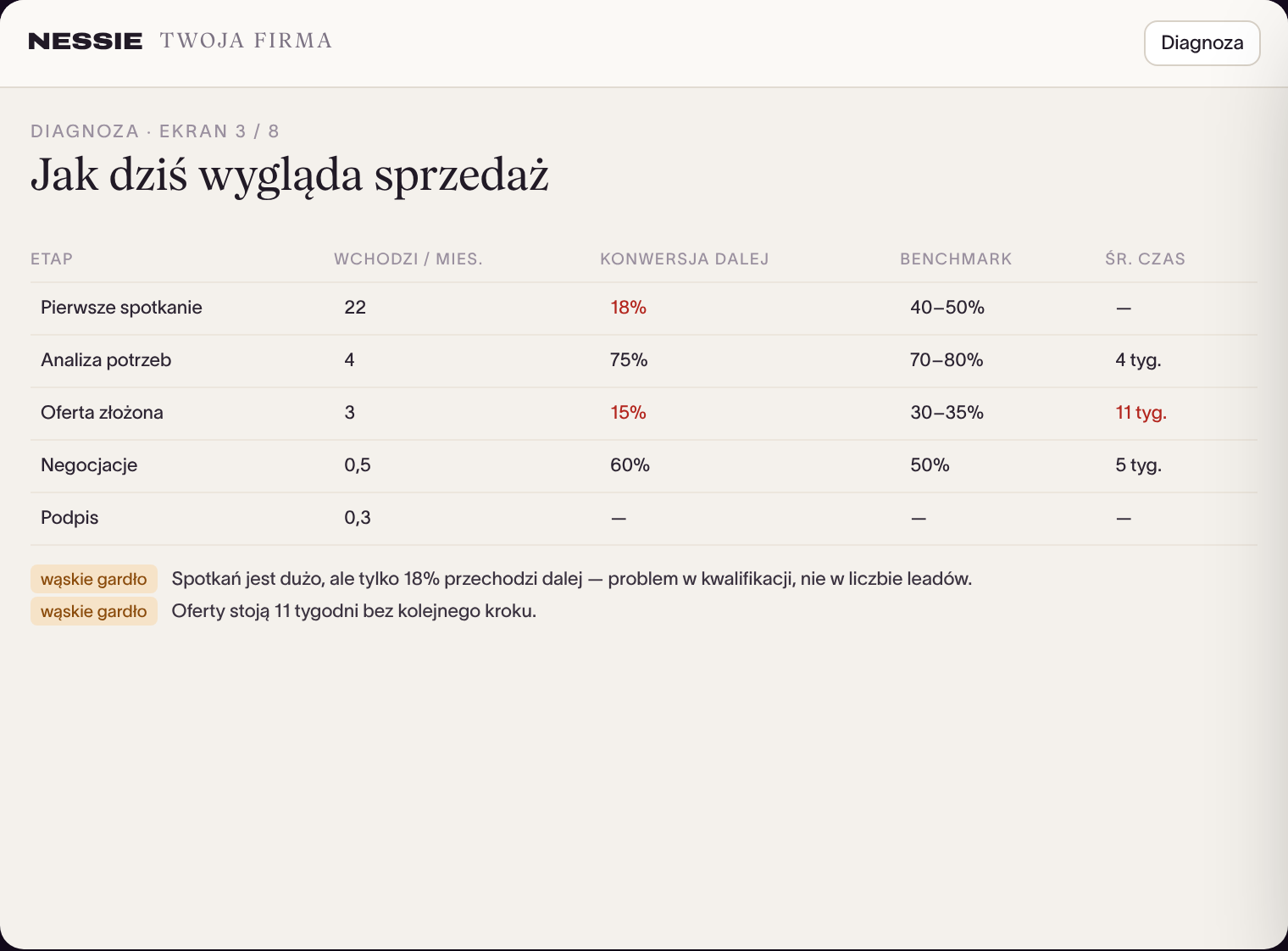
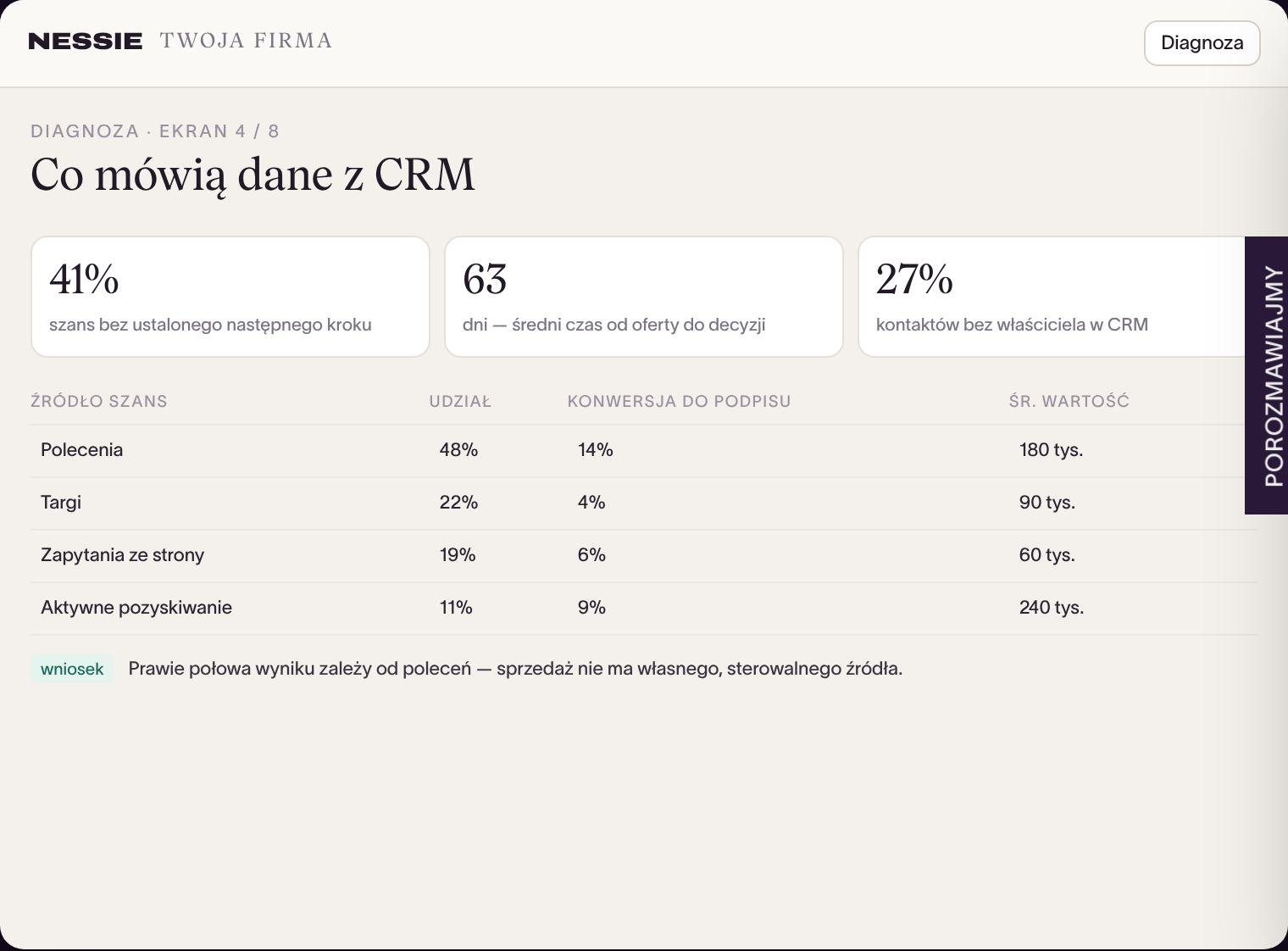
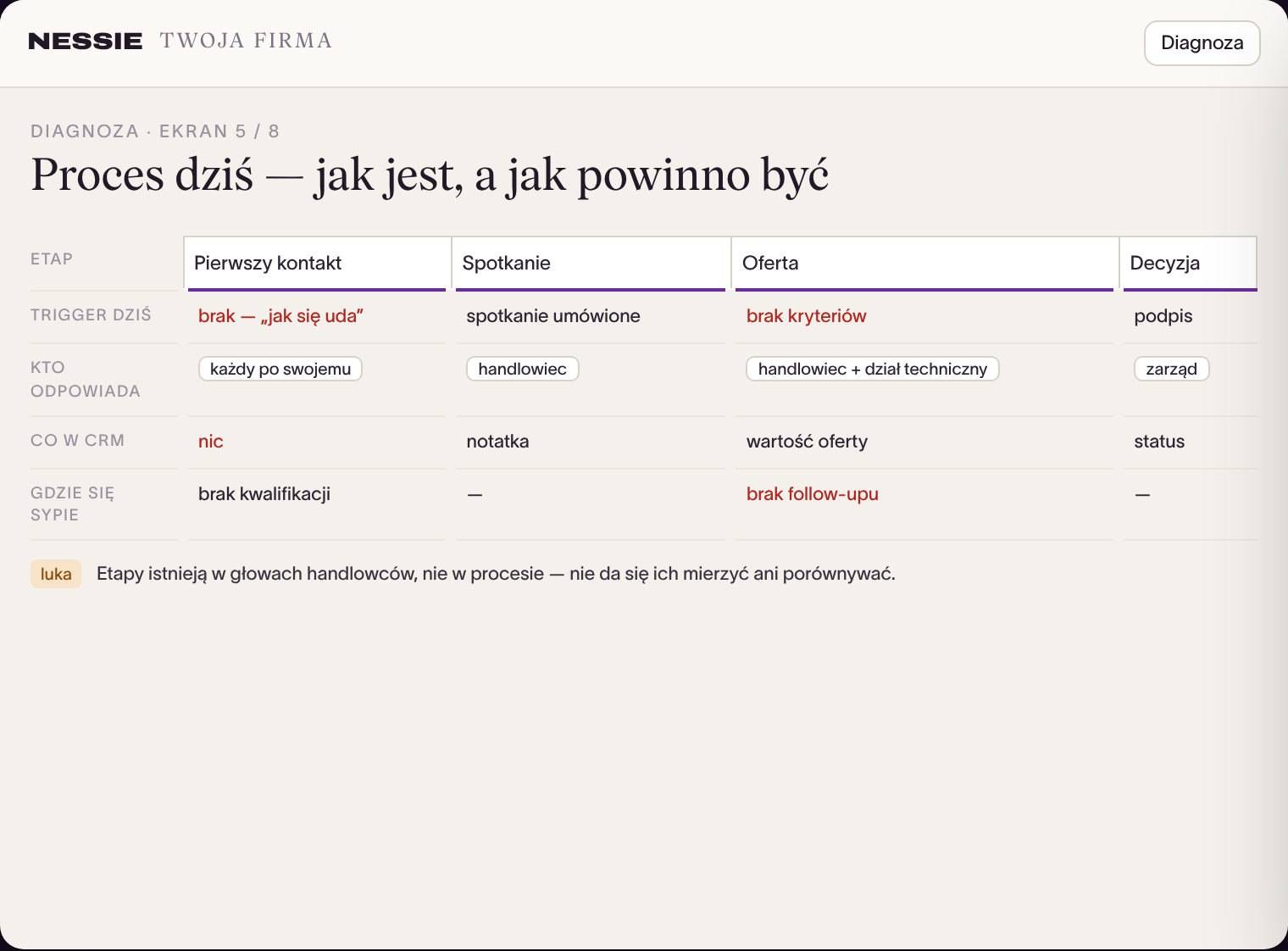
Eight areas — from the board's goal to the team's daily work.
What we work on: CRM and ERP exports (proposals, orders, invoices, client records), reports and forecasts, conversations with the board and the team, market sources.
How we work
Timeline
- Data, reports and materials the company wants and is able to share
- Kick-off meeting with the board — the goal of the diagnosis
- Sessions with sales managers and salespeople
- Analysis of data, reports and the CRM
- Report and change plan
- Board meeting — findings, priorities and order of changes
What the board gets
- A map of your sales — where opportunities stall, where they drop out and why.
- An answer on where the problem is — winning leads, closing, the team or the target; one-off or systemic.
- A plan of changes in order — what to do now and what comes next; the shortest route to the board’s goal.
- Recommendations for the team — based on conversations and data, not impressions.
When it makes sense
- Results fall short of the plan and nobody can clearly say why.
- There are plenty of meetings but few opportunities — or the opposite: opportunities that don’t turn into contracts.
- The board gets promises from sales instead of numbers and doesn’t know what the next quarters will bring.
- Before a big decision — hiring, entering a new market, changing the structure — you want to know where you stand.
A revenue target turned into numbers the board can see and control.
Which segments and clients the result should come from, how many enquiries and conversations are needed each month, how many people and what way of working. We agree this in workshops with the board, on the company’s data, always starting with a thorough diagnosis.
We take on going to market for you.
Choosing segments and decision-makers, first conversations and nurturing contacts in your CRM. Your team gets meetings with people who have real buying potential — and runs and closes the sales conversation itself. You see the numbers every week.
We teach your team to win new clients — until the process becomes its daily routine.
For 2 months we work hand in hand with your team on real contacts: segmentation, LinkedIn, CRM, prospecting and booking good meetings. You see results while the implementation is still running, and the know-how stays in the company.