Lead generation Nessie
Lead generation
We take on going to market. Your team talks to people who can actually buy.
Salespeople look after existing clients, answer enquiries and write proposals. There’s no time left to look for new companies, so new clients come from referrals, trade fairs or not at all. And when the board wants to enter a new market or segment, everything starts from zero: who to write to, what to say and how long it will take.
Nessie takes on lead generation: from choosing segments and decision-makers, through first conversations, to nurturing contacts in your CRM. The team gets meetings with people who have real buying potential — and runs and closes the sales conversation itself. You see the numbers every week.
How we do it
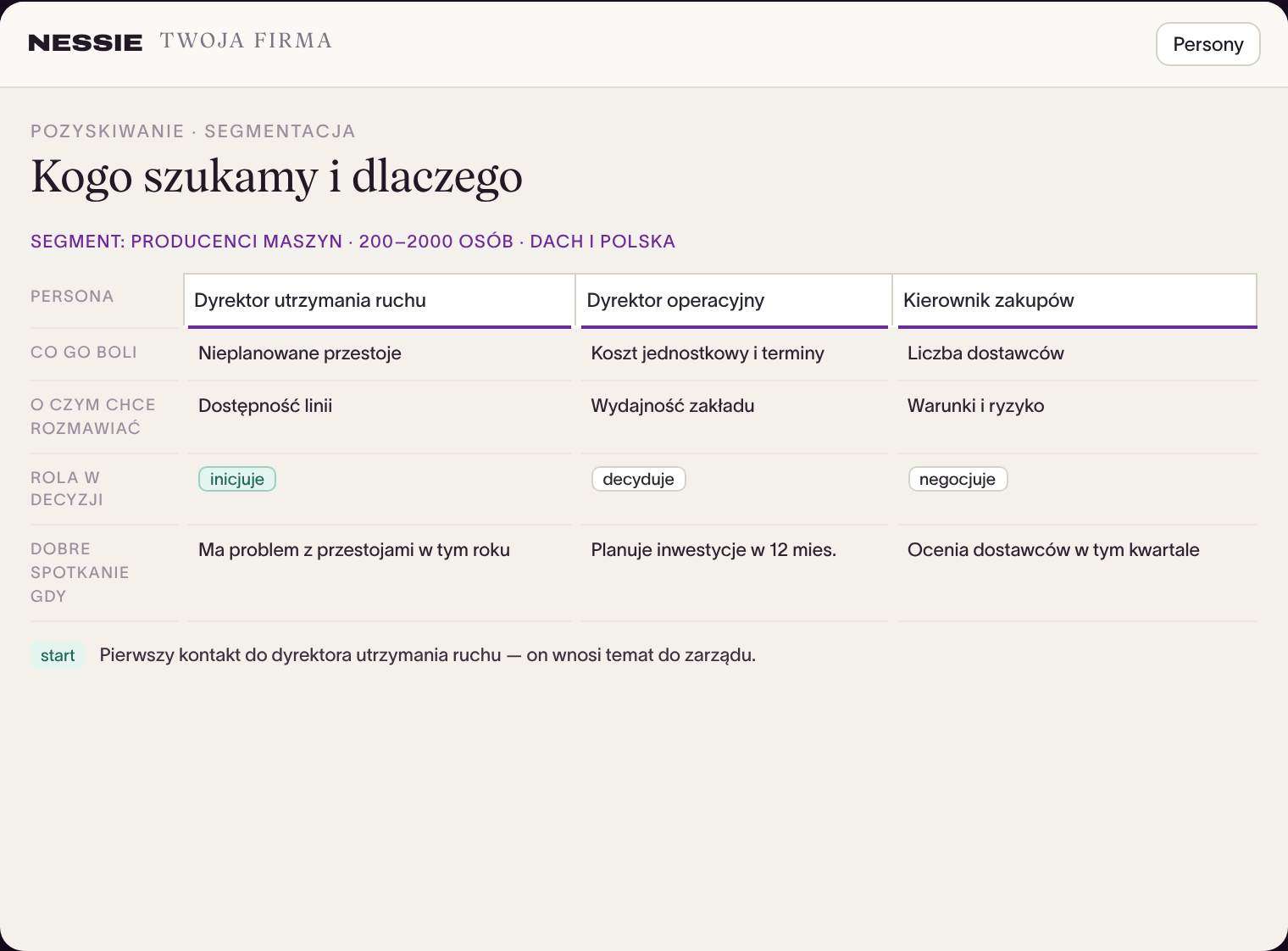
- segments, personas and what makes a good meeting — agreed with the board
- direct contact with specific people: LinkedIn and email on your company’s domain
- nurturing contacts and prospecting in your CRM
- a weekly status: numbers, conclusions and adjustments
- a predictable stream of quality meetings — and everything we build stays in the company











You're not buying meetings. You're buying the system that delivers them.
We’re not a mass-mailing agency — we don’t count messages sent or form fills. Nor do we sell for you: your team runs and closes the sales conversation, and we support it rather than compete with it. We work like a sales department: on personas, messaging and numbers, with a weekly check on what works. No ads, no posts, no e-books.
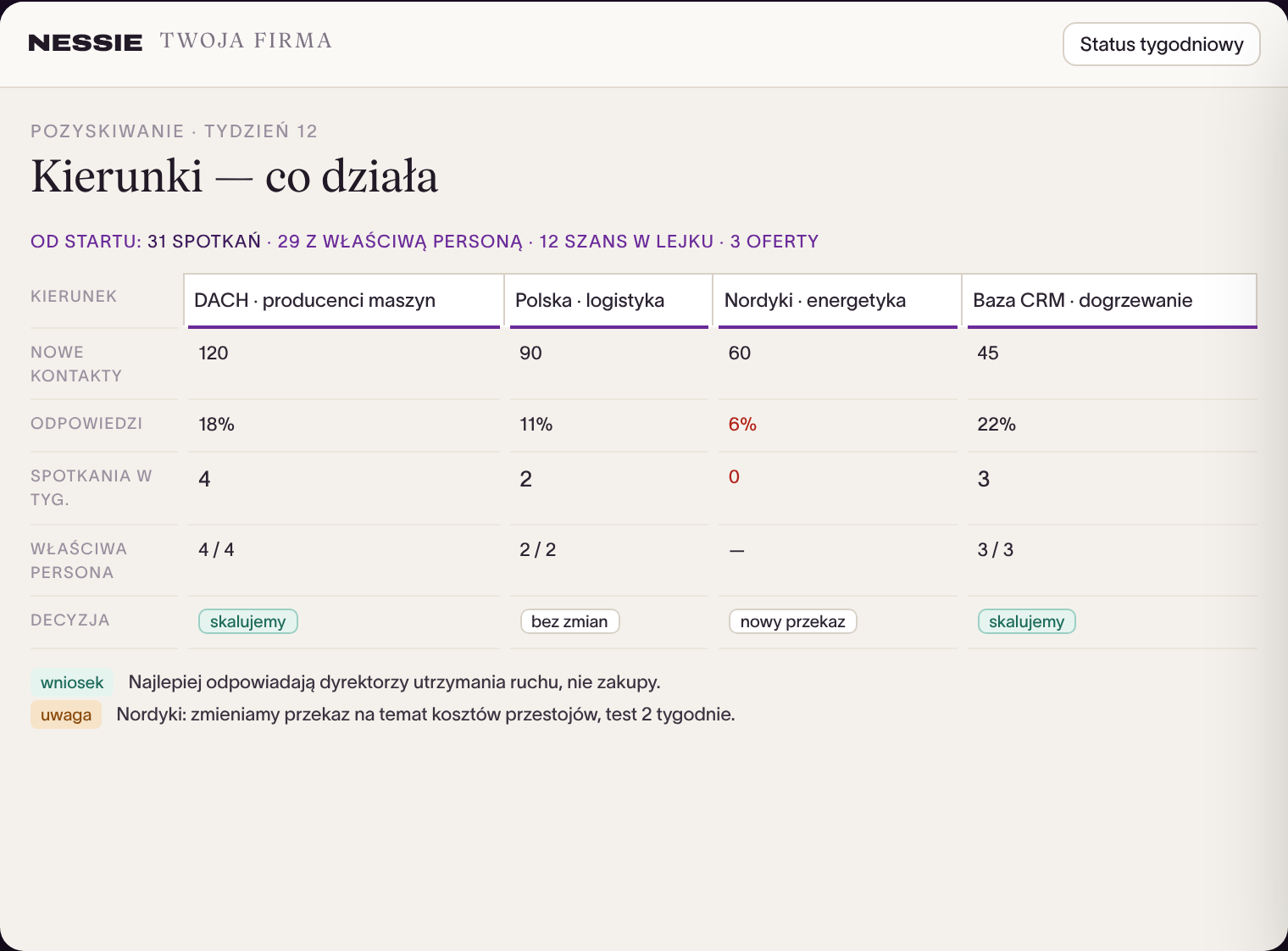
Every direction measured. What doesn't work, we change within 2–3 weeks.
We work several directions at once and check every week which segments and messages bring good conversations. This is what the weekly view looks like (on sample data).
From choosing the market to a meeting in the salesperson's calendar.
To start we need: LinkedIn with a Sales Navigator licence, an email address for the Nessie team on your domain with a shared calendar, CRM access and a channel for day-to-day communication.
How we work
Timeline
- Kick-off workshop — goal, markets, personas and what makes a good meeting
- Segmentation — lists of companies and people for each direction
- Messaging and message sequences for each persona
- Outreach starts — first meetings after 2–3 weeks
- Weekly statuses — numbers, conclusions, adjustments
- Scaling the directions that work
- Continue with us or roll it out in your team — the base, messaging and way of working stay in the company
New clients from a channel the company controls — instead of waiting for referrals.
When it makes sense
- New clients come mainly from referrals and trade fairs, and the company has no channel it controls.
- The board wants to enter a new market or segment where it has no contacts yet.
- Salespeople are busy with accounts and proposals — no time is left for winning new business.
- The sale is long and multi-stage, and several people decide on the purchase.
- You want to test the market before building your own lead generation team.
The real picture of your sales. More than reports, numbers and declarations.
An in-depth sales audit: two meetings with the board, conversations with the team and analysis of CRM data. At the end, a report and a plan of changes — where to start to see results as fast as possible.
A revenue target turned into numbers the board can see and control.
Which segments and clients the result should come from, how many enquiries and conversations are needed each month, how many people and what way of working. We agree this in workshops with the board, on the company’s data, always starting with a thorough diagnosis.
We teach your team to win new clients — until the process becomes its daily routine.
For 2 months we work hand in hand with your team on real contacts: segmentation, LinkedIn, CRM, prospecting and booking good meetings. You see results while the implementation is still running, and the know-how stays in the company.